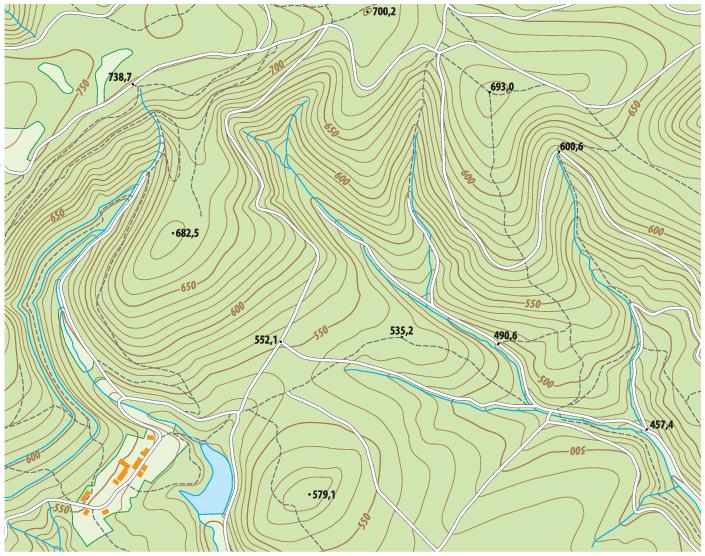
Contour lines are one of the most important features on a topographic map. They provide a visual way to represent the shape of the land, showing changes in elevation and helping readers understand hills, valleys, slopes, and depressions. Without contour lines, a flat map would offer very little insight into the three-dimensional nature of terrain.
Understanding the different types of contour lines is essential for anyone who uses maps, including surveyors, engineers, and planners. Each type of contour line serves a specific purpose and provides unique information about the landscape.
This article explains the main types of contour lines found on topographic maps, how they are identified, and why they are important for accurate terrain interpretation.
Index Contour Lines
Index contour lines are the most prominent and easily recognizable contour lines on a topographic map. They represent specific elevations and are usually drawn darker or thicker than other contour lines to make them stand out.
These lines are typically labeled with their elevation values, such as 100 feet, 500 feet, or 1,000 meters, depending on the unit system used. The spacing between index contour lines follows a consistent interval, known as the contour interval, which is stated in the map legend.
Index contour lines provide a quick reference for determining elevation and understanding the general shape of the terrain. By identifying these lines, map readers can easily estimate the elevation of surrounding areas and better visualize the land’s overall profile.
Intermediate Contour Lines
Intermediate contour lines appear between index contour lines and represent elevations that fall between the labeled intervals. These lines are usually drawn thinner and lighter than index contours, making them less visually dominant.
Their purpose is to show gradual changes in elevation and provide additional detail about the slope and shape of the land. Without intermediate contour lines, terrain features would appear overly simplified, especially in areas with gentle slopes.
Intermediate contour lines are particularly important for accurately interpreting rolling landscapes, shallow valleys, and gradual ridges. They help users understand how steep or flat an area is by showing how closely the lines are spaced.
Supplementary Contour Lines
Supplementary contour lines are used to represent minor elevation changes that do not meet the standard contour interval. These lines are typically drawn as dashed or dotted lines to distinguish them from regular contour lines.
They are most commonly found in relatively flat areas where standard contour intervals would not show subtle terrain variations. Supplementary contours help reveal features such as low ridges, shallow depressions, or slight rises in otherwise level terrain.
Although supplementary contour lines may not be as precise as surveyed contour lines, they provide valuable additional information that improves map readability and accuracy in low-relief areas.
Depression Contour Lines
Depression contour lines indicate areas where the land surface drops below the surrounding terrain. These contours are identified by short tick marks, known as hachures, pointing toward the lower elevation.
Unlike regular contour lines, which represent hills or slopes rising upward, depression contours show features such as sinkholes, craters, pits, or basins. Each closed depression contour represents a decrease in elevation toward the center.
Recognizing depression contour lines is critical for understanding drainage patterns and identifying possible hazards or water-collecting areas. They provide essential information for land development, environmental planning, and engineering projects.
Form Lines
Form lines are approximate contour lines that show general land shape without precise elevation measurements. They are usually drawn with broken or dashed lines and do not include labeled elevation values.
These lines are often used in areas where detailed surveying has not been conducted or where elevation changes are minimal. Form lines give a general sense of terrain shape rather than exact elevation data.
While form lines are useful for understanding overall landform patterns, they should be interpreted with caution. Because they lack precise measurements, they are not suitable for detailed engineering or construction planning but are helpful for preliminary analysis.
Conclusion
Contour lines are essential tools for representing elevation and terrain on topographic maps. Each type—index, intermediate, supplementary, depression, and form lines—plays a unique role in conveying accurate land information.
By understanding the differences between these contour line types, map users can better interpret terrain features, assess slope and elevation, and make informed decisions in navigation, planning, and development.